Seating
Wedding Seating Rules for Real Family Dynamics
Plan wedding seating for households, divorced parents, estranged relatives, close friends, and guests who need space—with clear rules and tact.
Start with comfort, not symmetry
A wedding seating chart is not just a capacity puzzle. It reflects households, friendships, caregiving needs, former partners, estranged relatives, and people who would simply enjoy the evening more with a little distance. The goal is not to encode every piece of family history. It is to record only the boundaries and connections needed to create a comfortable first draft, then review that draft with human judgment.
Begin with confirmed attendees and the relationships that materially affect placement: partners, parents, children, and caregivers who should remain together; guests who need mobility, communication, or meal support; friends or relatives who would appreciate familiar company; and people who need separate tables for comfort or safety.
Keep sensitive notes brief and operational. “Separate tables requested” is usually more appropriate than documenting the history behind the request. Share private context only with collaborators who genuinely need it.
Mira applies seating rules to guests marked as attending, so review your RSVP tracking and reminders before generating a draft. If responses are still changing, revisit the rules before finalizing the chart.
Separate required rules from preferences
Not every seating request deserves the same priority. Use a required rule when ignoring it would make the plan meaningfully wrong. “Must sit together” fits a child and guardian, a guest and caregiver, or another relationship that should not be split. “Must sit apart” fits a serious safety, distress, or boundary concern. “Seat at a table” pins a guest, household, or group when accessibility, caregiving, or the event structure makes the exact table important.
Use a preference when the outcome matters but can bend. “Try to sit together” works for friends, cousins, or coworkers. “Try nearby tables” keeps groups connected without requiring one shared table. “Prefer apart” gives people space while preserving flexibility when capacity or stronger constraints intervene.
In Mira, required rules express non-negotiable planning intent. The generator strongly considers them, but a generated draft is not a guarantee that every required rule was satisfied. Must-sit-apart and pinned-table rules exclude conflicting placements when a viable table exists, while must-sit-together rules receive strong placement priority.
If rules contradict each other, a required group exceeds table capacity, or no available table can satisfy every constraint, Mira can fall back to the best available placement rather than leave the draft unfinished. Treat validation warnings and draft review as required steps, especially when a rule concerns safety, caregiving, accessibility, or a firm family boundary.
Choose the right kind of distance
Divorced or separated parents do not need to be divided automatically. If both people are comfortable sharing a table, there is no reason to separate them. If a shared table would be tense, place them at different tables with people they know. Nearby tables can work when they should remain in the same general part of the guest plan without dining together.
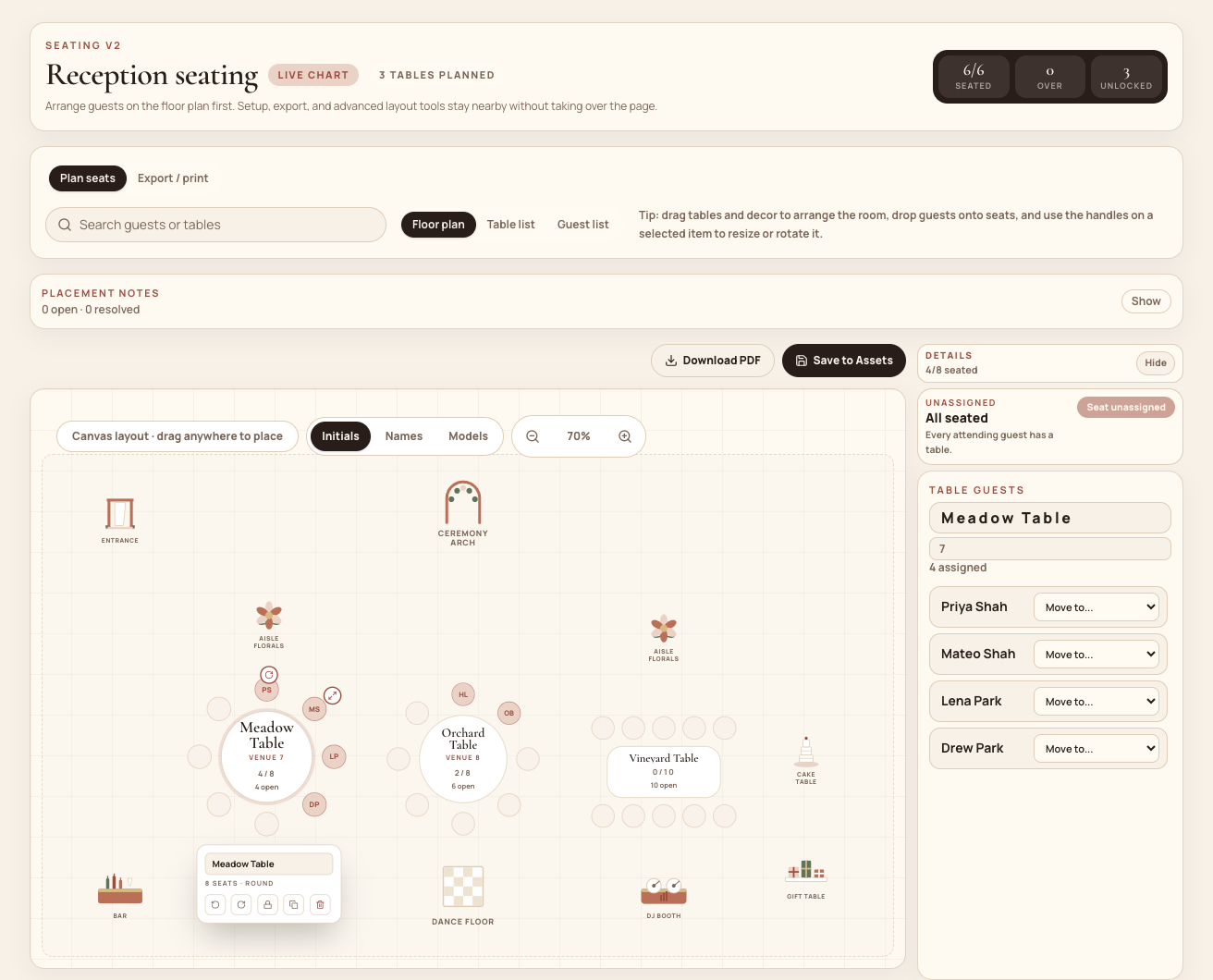
Mira currently interprets “nearby” through table ordering, not measured distance on the floor-plan canvas. Tables that are close in the ordered list receive preference; the generator does not inspect their physical coordinates. After generating the draft, confirm on the floor plan that the tables are actually as close—or as far apart—as intended.
For estranged relatives or active conflicts, use “Must sit apart” only when sharing a table would be genuinely wrong. For lower-level tension, “Prefer apart” preserves flexibility while steering the first draft toward separate tables.
Do not use seating as the entire response to a credible safety concern. Coordinate with your planner, venue, and trusted day-of contacts about arrival, photographs, alcohol service, transportation, and who should intervene if needed. A discreet question is more reliable than guessing from family roles.
Treat households as a starting point
Mira can keep households and couples together when it creates a seating draft. That is useful for most partners, parents, children, and plus-ones, but a household record describes an invitation party—not every relationship inside it.
Adult siblings may prefer their own friend groups. A teenager may be happier with peers. A plus-one who knows nobody else may need to stay with their host. A multigenerational family may fit better across nearby tables, and members of one household may have different accessibility needs.
Leave “Keep households/couples together” enabled when the household should move as one unit. If individual relationships matter more, split the placement and add specific rules for the people who should remain together.
Before making a large household or group required, compare its attending guest count with the largest available table. Mira warns when a together-rule needs more seats than the largest table provides, but you still need to decide whether to change the table plan or soften the rule.
Pin only genuine anchors
A pinned-table rule assigns a guest, household, or group to a specific table. Use it when the exact table matters: the couple at a sweetheart table, the wedding party at a head table, a guest near an accessible route, a caregiver near the person they support, or an immediate-family group tied to the ceremony or reception plan.
Avoid pinning everyone. Each fixed placement reduces the generator’s ability to balance capacity and honor other relationships. Pin the true anchors, use required relationship rules for firm boundaries, and leave social preferences flexible.
If all viable tables conflict with a pinned or separation rule, the generator may still produce a fallback placement. Confirm every critical anchor in the resulting draft before promoting it.
Review the draft like a person
Mira generates a what-if draft without changing the live seating chart. Use that separation to test your rules safely. Validation can identify issues such as oversized together-groups, overlapping separation targets, and rules involving guests who are not marked as attending. It cannot understand the full emotional context or prove that every fallback placement is acceptable.
A trusted relative or planner can help, but ask them only about relationships they understand. The final chart should reflect the people attending—not assumptions based on titles such as parent, sibling, or former spouse.
When your priorities are clear, use Mira’s wedding seating chart planner to turn them into tables and a floor plan. You can also create a free Mira workspace and begin with your attending guest list.
- Confirm every safety, caregiving, accessibility, and pinned-table rule manually.
- Check that each required-together group fits at an available table.
- Resolve overlapping targets, contradictory rules, and validation warnings.
- Verify that people marked “Must sit apart” do not share a table.
- Inspect the physical floor plan for every nearby-table preference; nearby uses table ordering, not canvas distance.
- Decide whether households and couples should remain together by default, then add individual exceptions.
- Give each guest at least one familiar connection where possible and avoid creating a leftovers table.
- Recheck rules and placements after RSVP, table-capacity, or floor-plan changes.
Common questions
Frequently asked questions
Should divorced parents sit at the same table?
Only if both are comfortable with it. They may share a table, sit at nearby tables, or sit in different parts of the room depending on the relationship. Ask privately when you are unsure and give each person familiar company rather than isolating either one.
What is the difference between “must sit apart” and “prefer apart”?
“Must sit apart” records a boundary the plan should not knowingly break. “Prefer apart” steers the draft toward separate tables but can yield when stronger constraints or capacity require it. Required rules still need manual confirmation because impossible or contradictory constraints can produce fallback placements.
Do couples and households always stay together?
Mira can keep households and couples together during draft generation, but you control that setting. It is a useful default, not a social rule. Large families, adult siblings, teenagers, and multigenerational households may be more comfortable split across coordinated tables.
Does “nearby tables” use the reception floor plan?
Not currently. Nearby preference is based on table ordering rather than physical canvas coordinates. After generating a draft, check the floor plan and move tables or guests if their real-world distance does not match your intention.
Put the rules into practice
Turn your guest relationships into a workable room plan.
Build a thoughtful first draft, inspect every required placement, and refine the tables without changing your live chart.